We have a fully funded PhD studentship (no competition funding interviews – just one round of selection) on predator-plant interactions based with us (the Foraging Ecology Research Group) here in Newcastle! Join a brilliant supervisory team with experience spanning molecular ecology, trophic interactions, network ecology and animal behaviour, comprised of Jordan Cuff, Fredric Windsor (Cardiff University), Darren Evans and Vivek Nityananda! The start date is 18th September 2024 (flexible) and applications need to be in by 15th December 2023.
Application instructions are live on FindAPhd.com!
Project overview
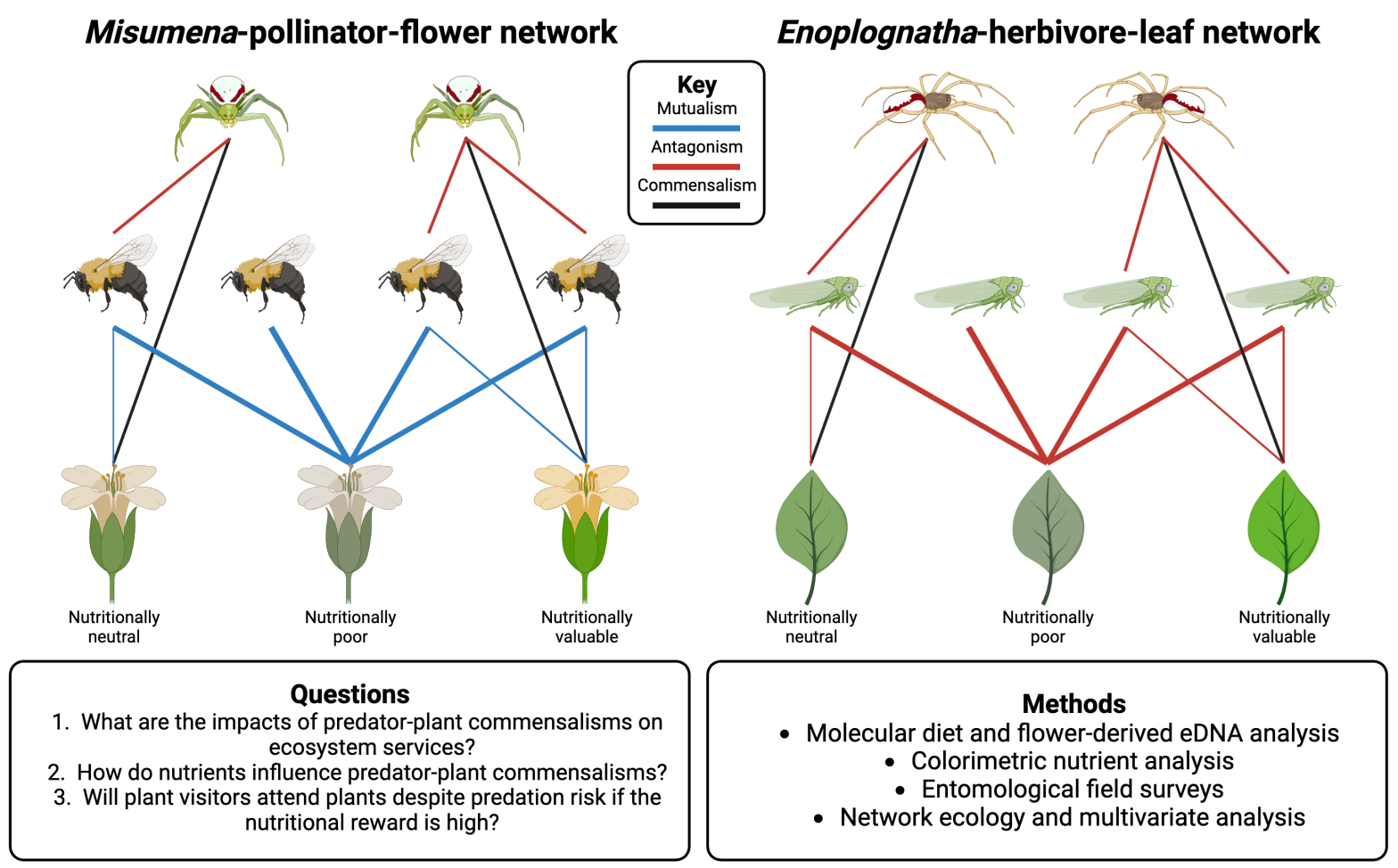
Invertebrate predators provide ecosystem services (e.g., biocontrol) and disservices (e.g., predation of beneficial insects)1 which influence crop production. Their commensalistic interactions with plants (e.g., shelter, reproduction) indirectly control their impacts, yet we know little about them2. The plants predators use determines the prey, and therefore nutrients, available to them, and nutrients will drive potential prey to interact with these plants3. Whether the presence of predators deters plant visitors, and how the quality of the nutritional reward affects this, could be important for conservation biological control.
Using model systems involving spiders and the plants they commensalistically use2, this project will explore how predator-plant commensalisms drive ecosystem service provision and how nutrients structure these interaction networks3. The project will include training in molecular dietary and eDNA analysis, nutrient analysis and entomological field surveys to construct and analyse merged networks4. Using network approaches to analyse the influence of nutrients on indirect interactions5 and ecosystem services will answer three key questions:
1. How do predator-plant commensalisms impact ecosystem services?
2. How do nutrients influence predator-plant commensalisms?
3. How does predation-nutrition risk-reward trade-off affect plant visitation and fitness?
References:
1. Cuff et al. 2022, Environmental DNA. 2. Cuff et al. 2022, Agricultural and Forest Entomology. 3. Cuff, Evans et al. 2022, Authorea. 4. Cuff, Windsor et al. 2022, Methods in Ecology and Evolution. 5. Tavella et al. 2022, Agriculture, Ecosystems & Environment.
 Foraging Ecology Research Group