Are you interested in using cutting edge techniques to unravel the complex belowground interactions of agricultural invertebrates? This PhD project involves constructing belowground food webs using DNA-based methods, ecoacoustics and emerging statistical approaches. Apply now!
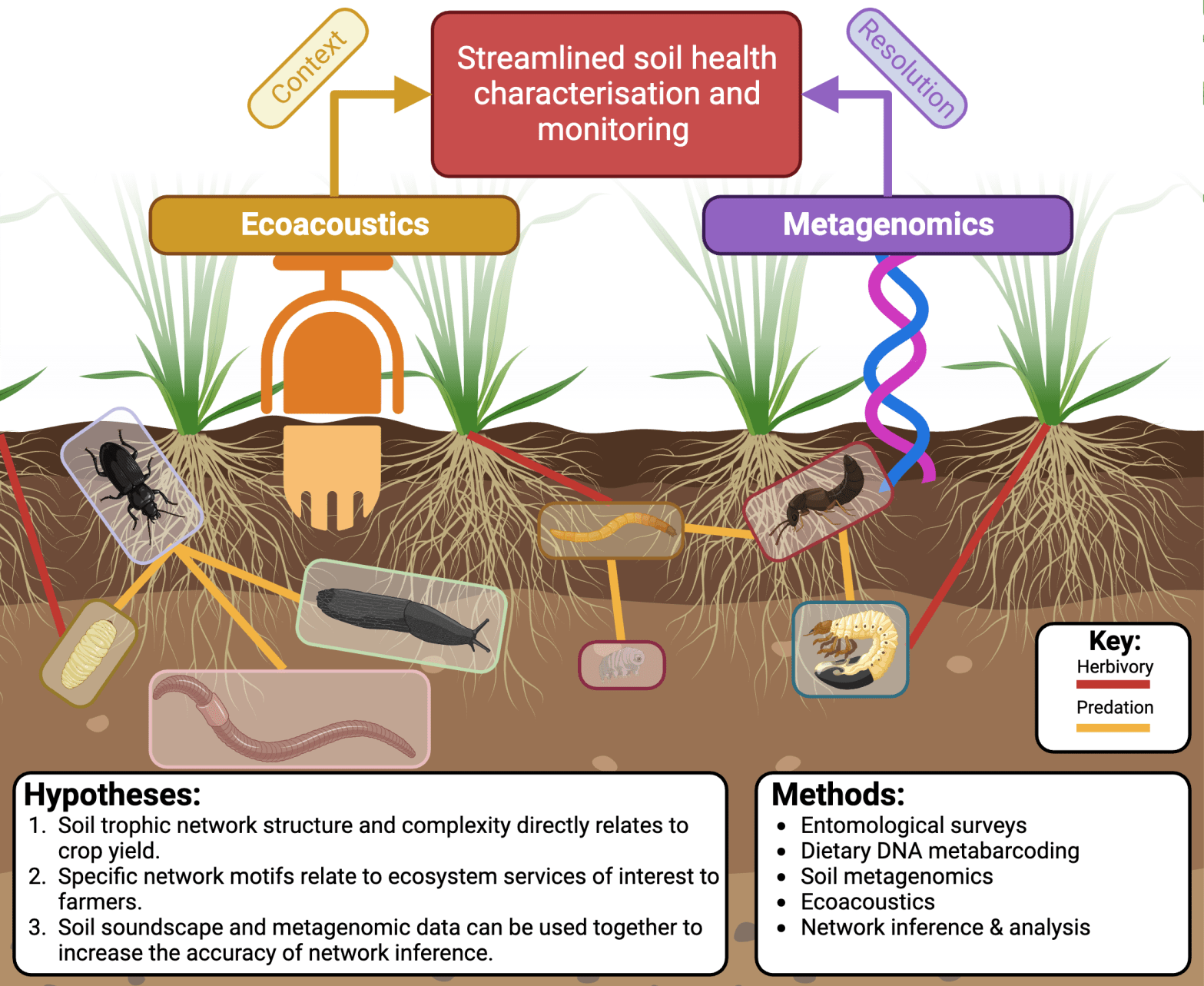
Soil health depends on complex invertebrate food webs which drive ecosystem processes and ultimately crop yields, but studying these cryptic interactions is difficult. Molecular methods can help with this. While community DNA from the soil can tell us which organisms are present, interactions between species are harder to infer. By merging molecular data with ecoacoustics (i.e., sounds from organisms in the soil), we aim to reconstruct these interaction networks more accurately. This will be a paradigm shift for soil health monitoring and our understanding of the crucial food webs within soil. This project will use a combination of dietary metabarcoding, soil metagenomics, ecoacoustics and network analysis to characterise, infer and analyse belowground food webs. Understanding these food webs is pivotal to designing and implementing effective integrated pest management.
You will join a thriving community of PhD students across both Fera and Newcastle University’s Ecology Group. The project will involve training in cutting-edge molecular ecological methods, novel data-merging approaches and state-of-the-art network analysis, with supervision from world-leading expertise in trophic ecology (Jordan Cuff, Newcastle), molecular diagnostics (James Kitson, Fera), network science (Darren Evans, Newcastle), agricultural entomology (Larissa Collins, Fera) and ecoacoustics (Carlos Abrahams, Nottingham Trent). This project will be based at Newcastle University with full access to the Molecular Diagnostics Facility, a fully equipped, state-of-the-art molecular analysis hub.
100% fees covered (Home fees rate) and a minimum tax-free annual living allowance of £17,668 (2022-23 UKRI rate). To support research and training, £6,600 consumables and travel budget will be available per year of study.
Applications are due by 31st January 2024 and application instructions are on the Newcastle University website.
 Foraging Ecology Research Group