
Applications are open for a NERC funded PhD studentship (competition funded, so two rounds of selection, the second with the funder) on network inference, the nutritional and trophic ecology of ground beetles, and their provision of ecosystem services. This PhD will involve joining our (the Foraging Ecology Research Group) lively and growing group of PhD students here in Newcastle! Join a brilliant supervisory team with experience spanning foraging ecology, molecular ecology and network ecology, comprised of Jordan Cuff, Michael Pocock (UKCEH) and David Bohan (INRAE)! Applications need to be in by midday (GMT) on the 3rd January 2024.
Background
The interactions of generalist consumers are crucial determinants of ecosystem structure and function, but they can also be difficult to predict given the many food sources generalists access, and the way in which these interactions dynamically change over space and time. As our ecosystems are impacted by global change, it is even more important that we can understand and predict these interactions to mitigate potential impacts to ecosystem stability. This is also crucial for understanding and optimising the provision of ecosystem services and disservices, which determine the benefits we gain from these interactions, such as predation of crop pests or, conversely, herbivory of crops.
Ecological networks are a valuable means for investigating interactions across whole communities or ecosystems to understand the function and stability of ecosystems, and the properties that structure interactions across space and time. This can be particularly crucial for understanding the impact of perturbations like global change on interactions and their outcomes, such as ecosystem services. Constructing these networks empirically can, however, be time-consuming and challenging, so finding streamlined ways to do so is paramount if we are to use networks across a broad range of spatiotemporal contexts. Inferring interactions is one such method, which involves linking consumers and resources in a way that should resemble the interactions actually occurring. This is particularly important for difficult-to-observe systems such as the interactions between invertebrate consumers and their resources.
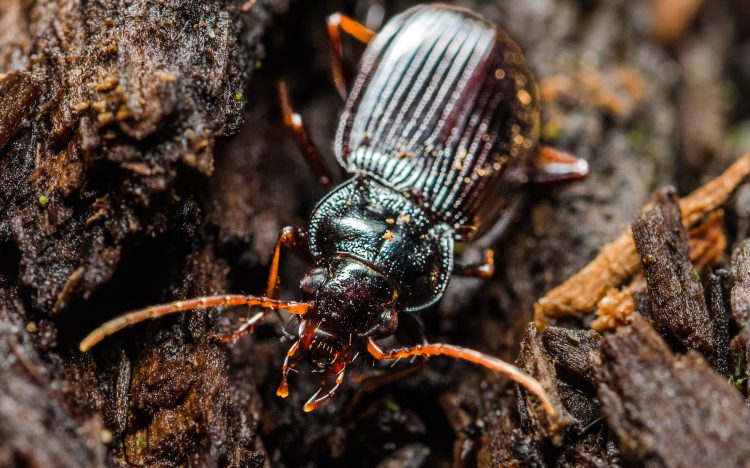
Many ground beetles (Carabidae) are highly abundant generalist omnivores, although some specialise on invertebrate prey or seeds. Given that they regularly consume weed seeds and crop pests, they are thought to be highly beneficial for agricultural productivity, but they can also consume beneficial invertebrates, such as other predators of crop pests, and they may also consume crop seeds. In order to advance our capacity for inferring interactions between invertebrate consumers and their resources, we first need to compare our inferences with known interactions. Such datasets do exist across some contexts, but we must also generate new interaction data in order to incorporate new data types within network inference models. The trophic ecology of invertebrate generalist predators, however, remains poorly understood given the difficulties associated with studying ecologically cryptic interactions of often nocturnal consumers. Molecular dietary analysis (e.g., dietary metabarcoding) circumvent this though, by allowing post-mortem reconstruction of dietary interactions long after they have occurred.
Using interaction and resource availability data, we can also begin to investigate the preferences of invertebrate consumers in the field by comparing their interactions with what we would expect them to interact with if foraging randomly. Understanding these preferences can help to refine network inference by defining likely preferential links between consumers and their resources. Such preferences are likely driven by the fundamental currency of trophic interactions: nutrients. By integrating nutrient contents into these ecological networks, we may be able to enhance our ability to infer interactions greatly.
This project will use existing ground beetle-seed interaction data to test network inference models, and then apply these to data generated from the field using dietary metabarcoding, nutritional analysis and null network modelling. This will enhance our ability to infer interactions accurately for the prediction and management of ecosystem services and disservices provided by ground beetles and other generalist consumers. This project will also generate crucial and novel insights into the foraging ecology and nutrition of generalist invertebrate omnivores beyond the reach of previous studies in this field.
 Foraging Ecology Research Group