We have a broad range of exciting projects underway at the moment, from PhD studies and funded collaborations to longer-term cross-cutting research streams.
Current externally funded projects
We are incredibly fortunate to receive funding from a wide range of sources to do some really exciting research! Some of these projects are described below:
New approaches to bridging individual-level foraging variation and ecological network structure in the Anthropocene
Project leads: Jordan Cuff (Newcastle University, UK) and Raul Costa-Pereira (Unicamp, Brazil)
Funding: NERC/FAPESP Global Partnerships Seedcorn Fund
Duration: November 2025 – October 2027
This collaborative project aims to develop a novel individual-to-community integrative framework for analysing foraging data across these scales by implementing conceptual, methodological and applied approaches. To achieve this, the project will combine digital and in-person workshops alongside empirical pilot studies to exchange and build capacity across continents, fostering the development of a novel analytical framework based on existing and newly generated data from both tropical and temperate ecosystems. Pilot studies will provide a real-world opportunity to refine the novel framework in two contrasting systems: populations of an invasive generalist snail in the tropics and arthropod communities under the influence of light pollution in a temperate agricultural landscape. Together, these activities will realise and demonstrate the full potential of bridging foraging research across levels of biological organisation and ecological contexts. By combining diverse expertise and worldviews, we aim to develop innovative ideas and pathways to apply an individual-to-community framework to larger projects and systems.
The project will initiate a partnership between Dr Jordan Cuff and Dr Raul Costa-Pereira, bridging the Foraging Ecology Research Group at Newcastle University, UK and the Intraspecific Diversity Lab at Universidade Estadual de Campinas, Brazil, with workshops throughout to widen participation further. This collaboration, fostered by shared academic interests and principles as early career scientists, has immense potential for significantly advancing our ability to study foraging across a range of scales, and elucidating the drivers and consequences of biodiversity loss in the Anthropocene.

Restoration for rare arable plants
Project lead: Phoebe Davies, Slade Farm Organics
Project partners/co-leads: Polly Davies, Slade Farm Organics; Josie Jackson, Slade Farm Organics; Jordan Cuff; Fredric Windsor, Cardiff University
Funding: Heritage Lottery Fund, Nature Networks Fund
Duration: 2024-2026
This project aims to connect threatened grassland ecosystems, restore rare arable plant habitats and connect local communities to their natural heritage and the ecosystem services it provides. This project focuses on disseminating knowledge to local communities, visitors, farmers, schools/students, and academic partners. The presence of rare arable plant species will be confirmed using iRecord data from the general public, formal surveys and a proof-of-concept study using environmental DNA methods to understand what invertebrates visit rare arable plants.
Building a benefit-risk model for reintroduction of Calosoma sycophanta as a biocontrol agent of oak processionary moth using molecular dietary analysis
Project leads: Max Blake and Kyle Miller, Forest Research
Project partners/co-leads: Jordan Cuff (Newcastle University), Katiana Saleiko (Forestry England), Andrew Hoppit (Forestry Commission), Neil Audsley (Fera Science Ltd.), Catherine Burton (JNCC)
Funding: Defra Future Proofing Plant Health
Duration: April 2025 – March 2027
This project will use molecular dietary analysis to study the trophic ecology of the forest caterpillar hunter (FCH; Calosoma sycophanta) in Turkey, Belgium/Netherlands and museum specimens from the UK, and determine its likely interactions in modern Britain. Using prey availability data at each site, we will construct null network models to determine the preferences of FCH and, by relating these to the prey available at OPM-infested sites in the UK, infer its likely interactions. By constructing wider ecological networks including these interactions, we will determine likely direct and indirect impacts of reintroducing FCH as the foundation for a benefit-risk analysis to inform decision-making around this possible reintroduction.
Impacts of drought on the community structure of subtropical leaf litter arthropods and their food-web interactions
Project lead: Petr Klimes, University of South Bohemia and Biology Centre CAS
Project partners/co-leads: Martin Fikacek, National Sun Yat-Sen University; Pavel Fibich, University of South Bohemia; Jordan Cuff (as external collaborator)
Funding: Czech Academy of Sciences
Duration: 2025-2028
This project aims to disentangle how arthropod communities and their interactions within leaf litter respond to drought, focusing on ants, spiders and beetles. The project will involve investigating the responses of community structure, species distribution and trophic interactions across seasons and in response to rain exclusion experiments across three sites, each based in a different climatic zone of a subtropical island. Our involvement is with the molecular analysis of trophic interactions, which will be carried out in Newcastle University.
Evaluating the potential of predator diet analysis as a monitoring tool for plant pests of concern
Project lead: Alice Walker, Forest Research
Project partners/co-leads: Jordan Cuff; James Kitson, Fera Science Ltd.; Molly Davidson, Forest Research; Christopher Hirst, Forest Research
Funding: Plant Health Centre, Scottish Government
Duration: 2025
This project will involve comprehensively reviewing the potential for predator dietary analysis to detect emerging and established plant pests, including: 1) a systematic review of current applications, 2) development of a decision-making framework for both targeted and generalised pest detection, 3) three broadly applicable case studies, and 4) an evaluation of alignment with existing policy and regulations.
Autonomous collection and analysis of airborne spores to protect fruit crops
Project lead: Michael Andreou, OptiSense Ltd.
Project partners/co-leads: Neil Boonham, Newcastle University; Jordan Cuff; Tim Williams, OptiSense Ltd.; Trevor Morgan, OptiSense Ltd.; Shailen Laxman, OptiSense Ltd.; Nigel Kitney, Nigel Kitney Farm Management Services; Tim Lacey, HL Hutchinson Ltd; Richard Glass, CHAP; Sophie Lane, CHAP; Corrie Halliwell, CHAP; Amy Skeels, CHAP; James Godber, CHAP; Rebecca Spencer, CHAP
Funding: Innovate UK
Duration: 2024-2026
This project aims to demonstrate the feasibility of automated spore sampling to improve decision making of farmers and agronomists using fungicides in the apple and grapevine sectors.
Read more about some of our work on this project, led by Lucy, on our page for ‘SporeDetect‘!
Primary PhD projects
We have an exceptional group of postgraduate researchers doing some incredible research in exciting areas. Below are a few of the PhD projects currently underway in FERG.
Investigating predator-plant commensalisms as indirect drivers of ecosystem services
Project lead: Rosy Christopher
Funding: Newcastle University Academic Track Fellowship
Duration: 2024-2027
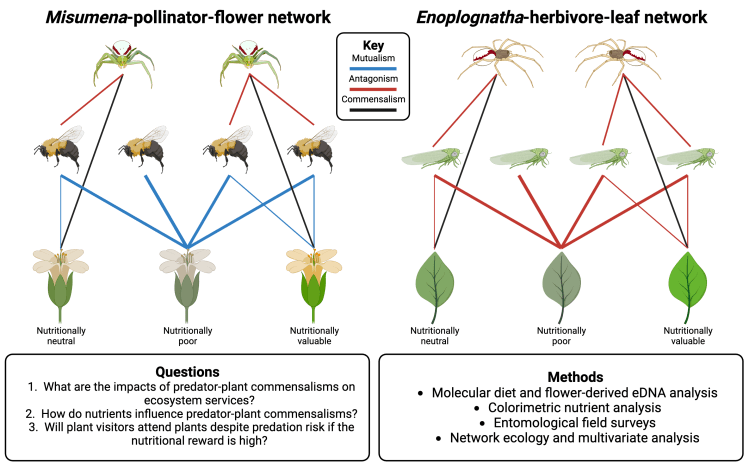
Invertebrate predators provide ecosystem services (e.g., biocontrol) and disservices (e.g., predation of beneficial insects) which influence crop production. Their commensalistic interactions with plants (e.g., shelter, reproduction) indirectly control their impacts, yet we know little about them. The plants predators use determines the prey, and therefore nutrients, available to them, and nutrients will drive potential prey to interact with these plants. Whether the presence of predators deters plant visitors, and how the quality of the nutritional reward affects this, could be important for conservation biological control.
Using model systems involving spiders and the plants they commensalistically use, this project will explore how predator-plant commensalisms drive ecosystem service provision and how nutrients structure these interaction networks. The project will use molecular dietary and eDNA analysis, nutrient analysis and entomological field surveys to construct and analyse merged networks. Using network approaches to analyse the influence of nutrients on indirect interactions and ecosystem services will answer three key questions:
- How do predator-plant commensalisms impact ecosystem services?
- How do nutrients influence predator-plant commensalisms?
- How does predation-nutrition risk-reward trade-off affect plant visitation and fitness?
Read more about part of Rosy’s project on our page for ‘Spider Spies‘!
The impact of artificial light at night on optimal foraging, trophic networks and ecosystem services
Project lead: Mia Croft
Funding: Natural Environmental Research Council OnePlanet DTP
Duration: 2024-2028
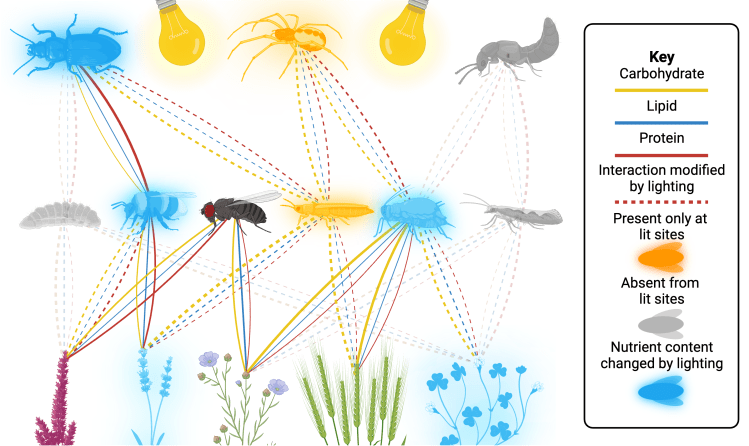
Artificial light at night (ALAN) affects invertebrate abundance and function with downstream impacts on ecological processes and ecosystem services including trophic interactions and nutrient cycling. Nutrition and foraging are inherently linked and, as these change, animals will seek optimal resources and patches, likely driving observed community structure changes under ALAN. This will, in turn, impact local provision of ecosystem services such as pollination and predation, thereby effecting both natural and semi-natural systems. The drivers of these changes are, however, poorly understood.
This project will use equipment and expertise from Newcastle University’s Molecular Diagnostics Facility to identify and compare ecological interactions at paired lit and unlit sites. Using techniques such as floral eDNA and dietary metabarcoding, and nutrient analysis, this project will compare trophic interactions and nutrient contents between paired lit and unlit sites. These data will be used to construct networks to determine how interactions are structured by ALAN and the consequences for ESs. The project will address the following questions:
- How does nutrient availability for predators and pollinators change under artificial lighting?
- Are community structural changes under artificial light driven by foragers seeking nutritionally optimal resources or patches?
- What is the impact of these changes on ecosystem service provision?
Read more about some of Mia’s work on our page for ‘Bright Lights, Bug City‘!
Building below-ground invertebrate trophic networks for soil health monitoring using metagenomics and ecoacoustics
Project lead: Will Dawson
Funding: Institute for Agri-food Research and Innovation (Fera Science Ltd. & Newcastle University)
Duration: 2024-2027
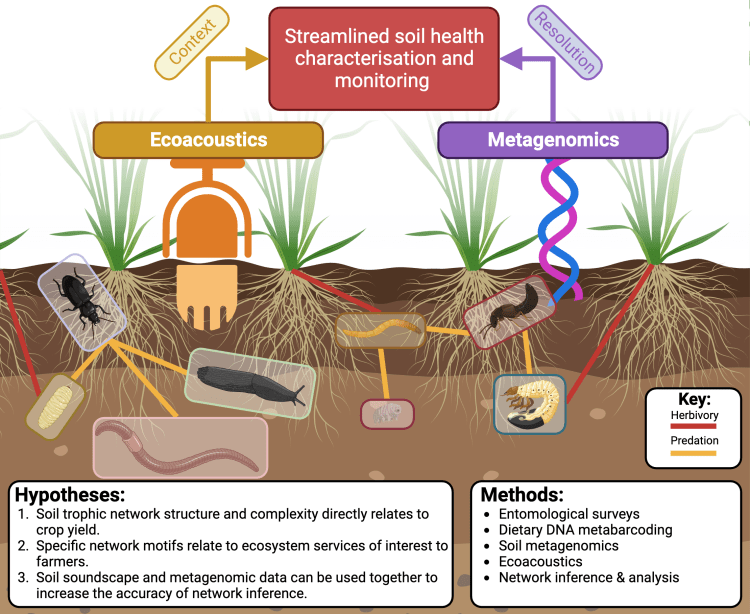
Soil health depends on complex invertebrate food webs which drive ecosystem processes and ultimately crop yields, but studying these cryptic interactions is difficult. Molecular methods can help with this. While community DNA from the soil can tell us which organisms are present, interactions between species are harder to infer. By merging molecular data with ecoacoustics (i.e., sounds from organisms in the soil), this project aims to reconstruct these interaction networks more accurately. This will be a paradigm shift for soil health monitoring and our understanding of the crucial food webs within soil. This project will use a combination of dietary metabarcoding, soil metagenomics, ecoacoustics and network analysis to characterise, infer and analyse below-ground food webs. Understanding these food webs is pivotal to designing and implementing effective integrated pest management.
Based across both Fera Science Ltd. and Newcastle University, this project involves cutting-edge molecular ecological methods, novel data-merging approaches and state-of-the-art network analysis, with supervision from world-leading expertise in trophic ecology (Jordan Cuff, Newcastle University), molecular diagnostics (James Kitson, Fera Science Ltd.), network science (Darren Evans, Newcastle University), agricultural entomology (Larissa Collins, Fera Science Ltd.) and ecoacoustics (Carlos Abrahams, Nottingham Trent University). The project will address the following questions:
- Does soil trophic network structure and complexity relate to crop yield?
- Are specific network motifs related to agricultural ecosystem services?
- Can ecoacoustics be used alongside metagenomics to infer ecological networks accurately?
Broader long-term projects
Below are a few longer-term projects that we’re constantly working on, often as part of other projects.
Integrating nutrients into ecological networks
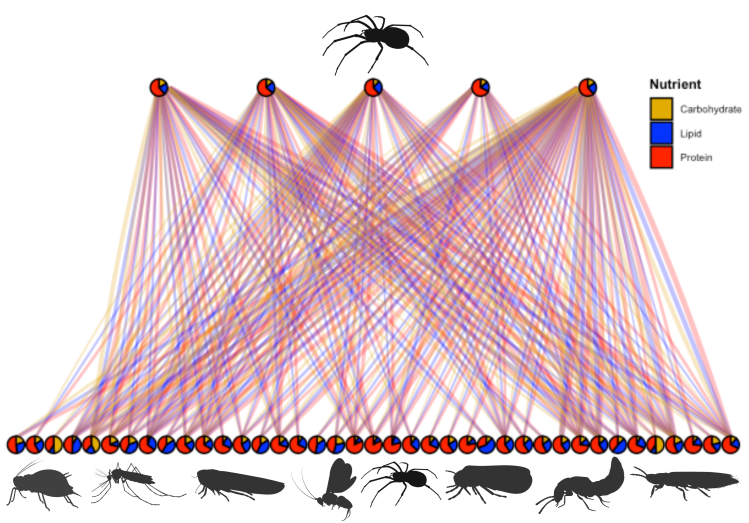
Nutrients are unquestionably important in driving trophic interactions, but they have been poorly integrated into network ecology. We are looking to change that! We have demonstrated the concept of ‘nutritional networks’ and proposed an array of hypotheses that can be tested through this framework. We are continually investigating how nutrients structure ecological networks, focusing not just on predator-prey systems, but also plant-pollinator mutualisms and plant-predator commensalisms.
Identifying fundamental determinants of animal foraging and trophic interactions
Alongside nutrients, many other biological factors and processes constrain, dictate and drive trophic interactions. We will be investigating how everything from biomechanics and the environment to evolution and molecular biology drive foraging ecology. This will involve collaborative interdisciplinary and transdisciplinary approaches to some complex questions at both the core and periphery of ecology.

Advancing molecular analysis of trophic interactions and ecological communities
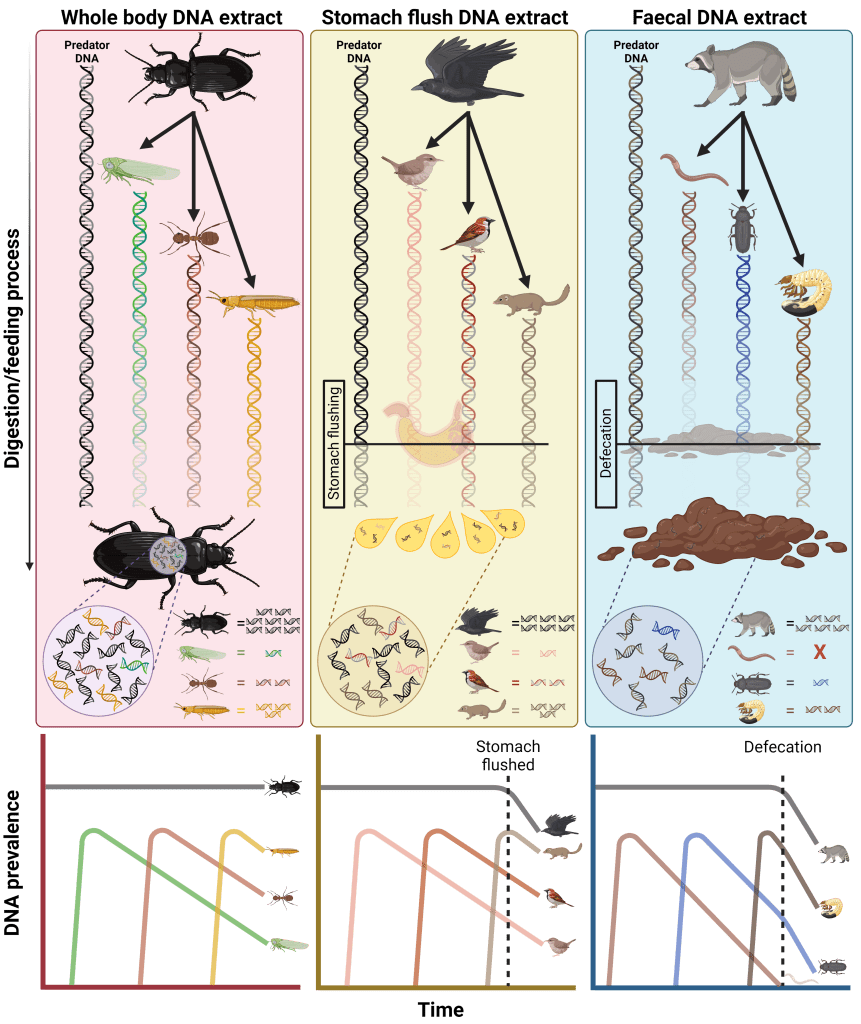
We are constantly looking for ways to improve our ability to detect and identify trophic interactions in the field. Molecular methods have offered great advances in this field over the last two decades, and this progress has not stalled. New technologies, concepts and approaches are unlocking opportunities for increasingly resolved, contextual and scalable analyses of trophic interactions from an ever-broadening range of taxa and systems.
Past projects
Scoping the feasibility of reintroducing the Forest Caterpillar Hunter (Calosoma sycophanta) as a potential biocontrol agent for Oak Processionary Moth (Thaumetopoea processionea) (OPM) in the UK
Project lead: Max Blake, Forest Research
Project partners/co-leads: Kyle Miller, Forest Research; Katiana Saleiko, Forestry England; Andrew Hoppit, Forestry Commission; Neil Audsley, Fera Science Ltd; Catherine Burton, JNCC; Luc Crevecoeur, EU LIFE Oak Processionary Group; Luc De Bruyn, EU LIFE Oak Processionary Group; Jordan Cuff
Funding: Defra Future Proofing Plant Health
Duration: 2024-2025
This project was an investigation of the feasibility of re-introduction of a potentially locally extinct generalist predator, potentially providing a pathway toward essential biocontrol of an invasive forestry pest.
 Foraging Ecology Research Group