

Check out this exciting new paper! Networking nutrients: How nutrition determines the structure of ecological networks
We provide a synthesis on the interface between nutritional and network ecology and demonstrate its potential for ecological research.
Nutrients determine the frequency and identity of interactions, and ecosystem services and function. They therefore also play a significant role in structuring ecological networks. We propose and demonstrate their integration into networks, and the hypotheses underpinning it.
Various ecological concepts and theories underpin the importance of nutrients in networks. From generalism/specialism and nutrient-specific foraging to system-level nutrient limitation and naivety to new resources, the fitness consequences of nutrition influence interactions.

This theoretically translates to functional responses, which have been linked to the nutrient content of resources before. We summarise and hypothesise how these relationships might look for prey of different nutrient contents, and how this will manifest in network structures.
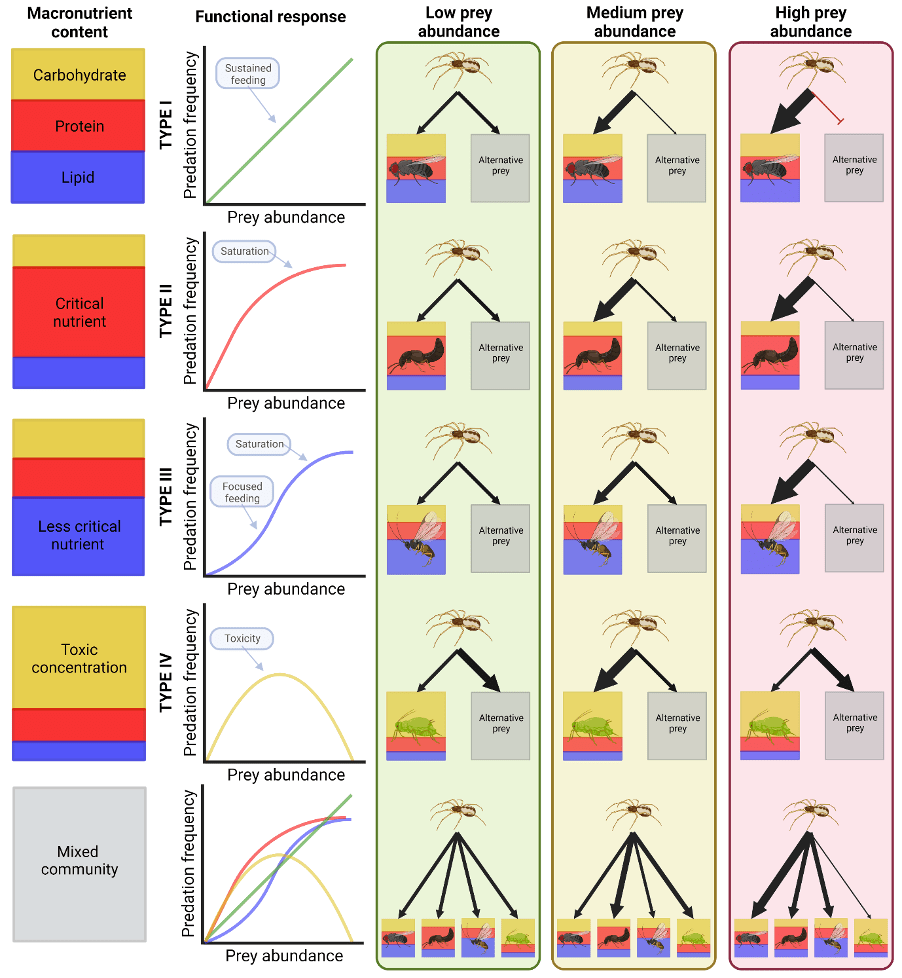
Variation in the availability of nutrients over time and space will also affect ecological networks, both for local species and long-distance migrants. Nutrition could rationalise the interactions of invasive species and explain interaction rewiring and network robustness.
To integrate nutrients into networks, they could be represented as (i) links, (ii) nodes (by clustering taxa based on nutritional similarity), or (iii) nodes of their own (i.e., consumers interact with nutrients). Each enables investigation of different ecological phenomena.
To do any of these in practice, we need interaction data, resource nutrient content data and a healthy dose of network science. Few studies present both interaction and nutritional data, so we used data from a previous study to demonstrate the concept.
By constructing three overlapping networks (each for a different nutrient) in which the links are weighted by the transfer of nutrients between resource and consumer, we can begin to characterise and compare the structure of the networks and see how nutrients influence them.

Using null models that randomly redistribute nutrient contents among resources, we see that the nutritional networks are structured non-randomly, and the properties differ again between nutrients. We discuss some explanations for these properties and how nutrients drive them.
Nutrients are not the sole driver of interactions and nutritional networks are not a panacea, but they could advance our understanding of ecological systems. Integrating nutrients into networks may reveal the mechanisms underpinning network assembly, functioning and structure.
This manuscript was a labour of love for Jordan alongisde the dream team of Darren Evans, Ian Vaughan, Shawn Wilder, Max Tercel and Fred Windsor. Stay tuned for some really exciting applications and innovations on this topic over the coming years!
 Foraging Ecology Research Group
One thought on “NEW PAPER: Networking nutrients: How nutrition determines the structure of ecological networks”