
Check out the latest paper from the group: Prey nutrient content is associated with the trophic interactions of spiders and their prey selection under field conditions! We show that the interactions of spiders relate to prey nutrient contents and this is likely driving prey preferences, which vary nutritionally between spider genera, life stages and sexes!
Nutrient-specific foraging, the theory that generalist predators balance their nutrient intake based on their nutritional needs, is fundamental to our understanding of trophic interactions, but evidence for invertebrate predators engaging in it is mostly restricted to lab studies. These provide an excellent medium for in-depth studies and isolation of specific effects, but they don’t always perfectly reflect the complexity of natural systems. If we want to understand and predict interactions in the field, we need to investigate these drivers of interactions in a field context too. This has traditionally been incredibly difficult due to the paucity of methods available for determining the diet of (often fluid-feeding) invertebrate predators and the nutrient contents of their prey. Over the last few years, we have been working to address these shortcomings to finally explore the nutritional dynamics of invertebrate predators in the field.
We used dietary metabarcoding, prey choice null network models and micro-scale macronutrient assays to investigate whether nutrients drive trophic interactions and prey choice in the field, using spiders as a model group. Together, these methods tell us what the spiders are eating, what the nutrient content of those prey is, and what preferences/selectivity the spiders exhibit in the field.

By comparing the mean nutrient contents of the prey in each spider’s diet, we found differences in the diets of spiders across genera, sexes and life stages, showing that spiders in each of these groups are likely occupying different nutritional niches.

We then compared these dietary nutritional profiles to the nutritional profiles we would expect if they were just eating prey randomly based on their availability (determined by null models). We found that individual spiders were disproportionately foraging for all three macronutrients in greater proportions than expected, which could represent static nutritional preferences, or snapshots of the process of redressing nutritional deficits (i.e., spiders that had eaten a lot of protein-rich prey may move on to eating lipid-rich prey to redress a lipid deficiency). With our data it’s not possible to know for certain, but it’s certainly consistent with what we might see as a result of nutrient-specific foraging.

Each of the spider groups also exhibited preferences for prey with different nutrient contents. Most strikingly, all of the money spiders (Linyphiidae) had at least one strong preference for a carbohydrate-rich prey taxon, but the identity of that prey changed between genera – this could suggest that they are differentiating their sources of carbohydrate to reduce competition!

Sexes and life stages exhibited nutritionally distinct preferences, with male spiders having preferences for carbohydrate-rich prey that females didn’t (they even avoided one carbohydrate-rich taxon). Adult spiders similarly had more carbohydrate-rich prey preferences than juveniles, which had stronger preferences (and some avoidances) for protein-rich prey.
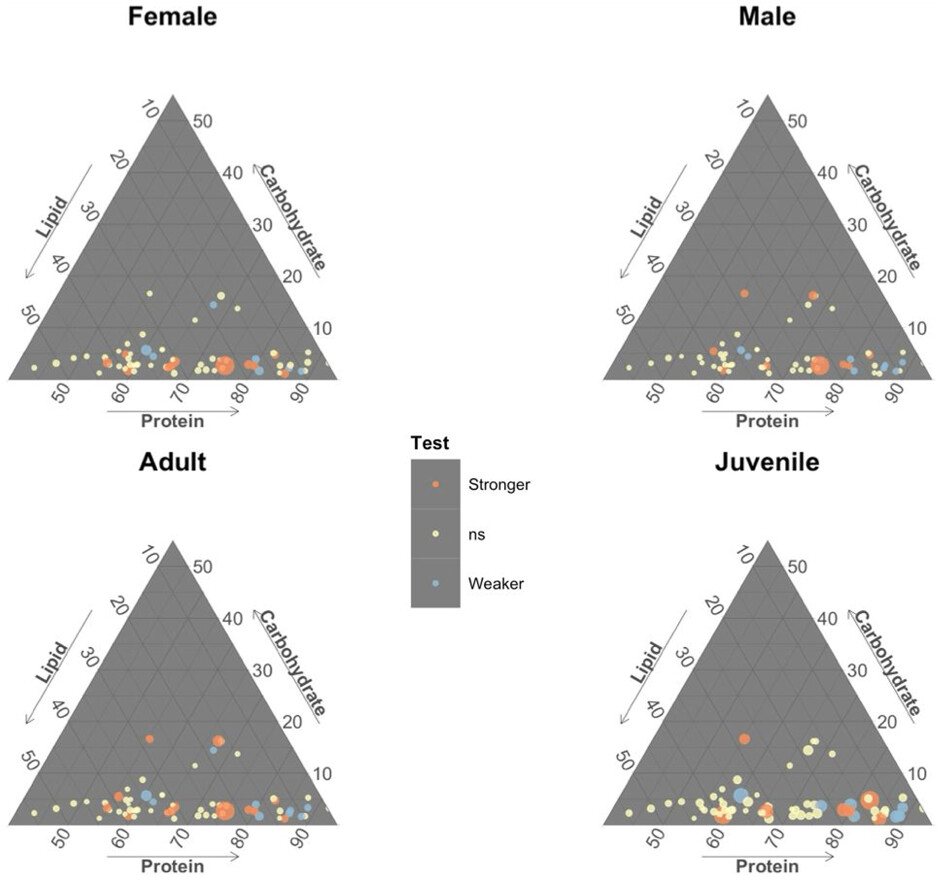
All of these findings together show that nutrients are likely driving trophic interactions in these spiders, elicited through adaptive prey choice. This is a really exciting insight into the nutritional dynamics of invertebrate predators in the field! Whilst we can’t confirm nutrient-specific foraging is the outright mechanism driving these interactions, this evidence is a first step toward showing that for certain.
This is the culmination of Jordan’s PhD work – it’s taken a while (3.5 years in review)! Given the complexities of the work, it has necessarily evolved greatly over this period (the earliest version is still visible in Jordan’s thesis, and a mid-point can be seen in the associated preprint – almost every aspect has changed over this time, so you could call it the ‘thesis of Theseus’). The final version is hopefully a great example of how and why we need to integrate different data types to answer fundamental ecological questions. These analyses were really exciting to conceptualise, run and tweak, and hopefully provide a framework for others to explore similar questions in other systems. These explorations also indirectly gave rise to the ‘nutritional network‘ concept. This is only the beginning of more really exciting research to come along these lines!

It was an excellent collaborative endeavour with Jordan’s PhD supervisors (Bill Symondson, who sadly didn’t get to see this published, Ian Vaughan, James Bell, Carsten Müller and Pablo Orozco terWengel), co-PhDers (Max Tercel and Lorna Drake) and the ever-excellent Shawn Wilder.
 Foraging Ecology Research Group
One thought on “NEW PAPER: Prey nutrient content is associated with the trophic interactions of spiders and their prey selection under field conditions”