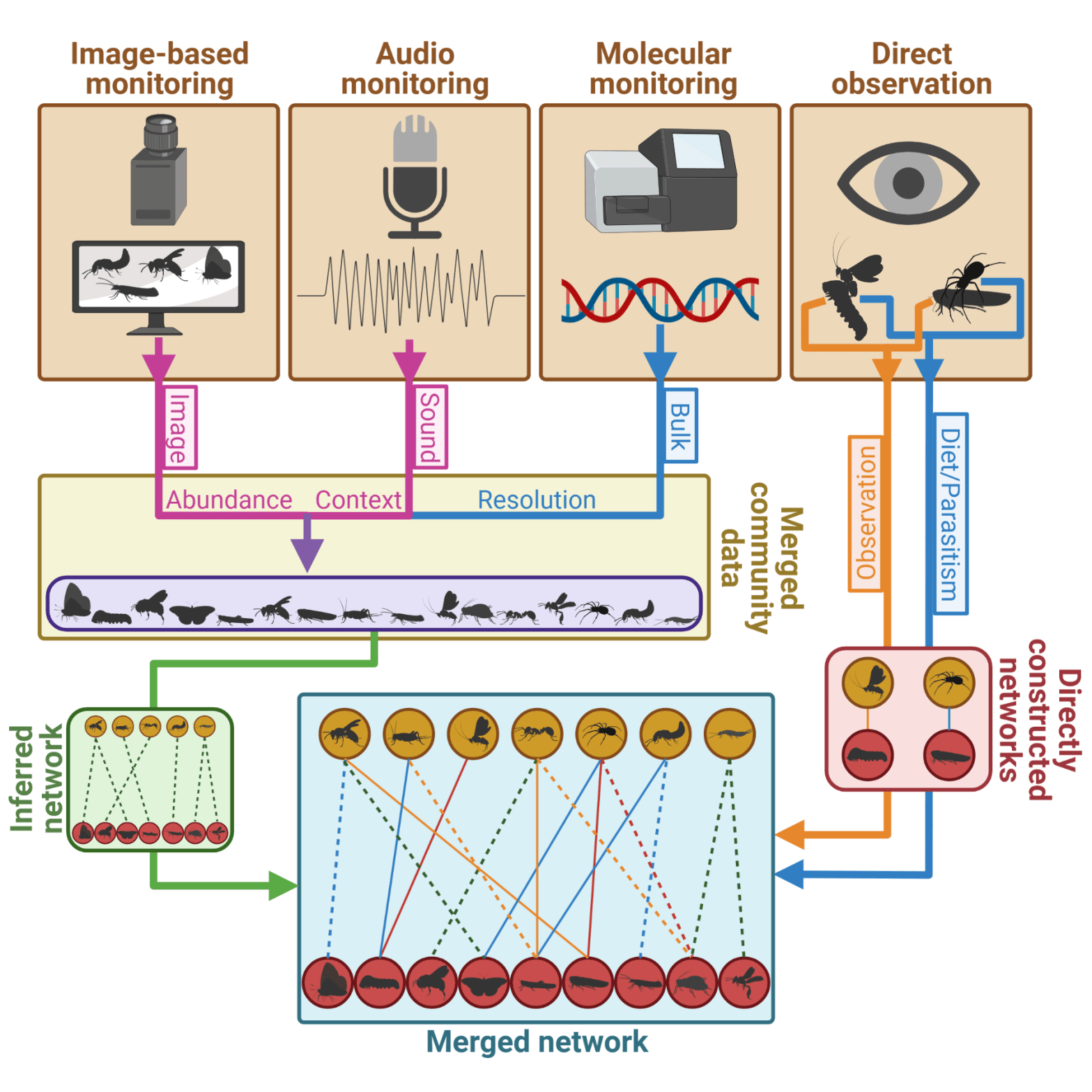
Check out this new chapter in Advances in Ecological Research: A roadmap for biomonitoring in the 21st century: Merging methods into metrics via ecological networks! This was a collaborative endeavour involving most of the Network Ecology Group.
The need for widespread, rapid and accurate biomonitoring has never been greater. We summarise some of the massive progress underway across various methods, how they can be merged and networks inferred, and how this can translate to useful metrics for biomonitoring!
Five years ago, Derocles et al. described how network science could bridge biodiversity and ecosystem functioning for biomonitoring, particularly via molecular methods. A lot of progress has been made, but networks remain poorly represented in monitoring.
Massive strides have been made across molecular, image-based and acoustic monitoring, and advances in computation make automated data processing and analysis a reality. All of these approaches have unique biases and benefits, but they remain poorly integrated.
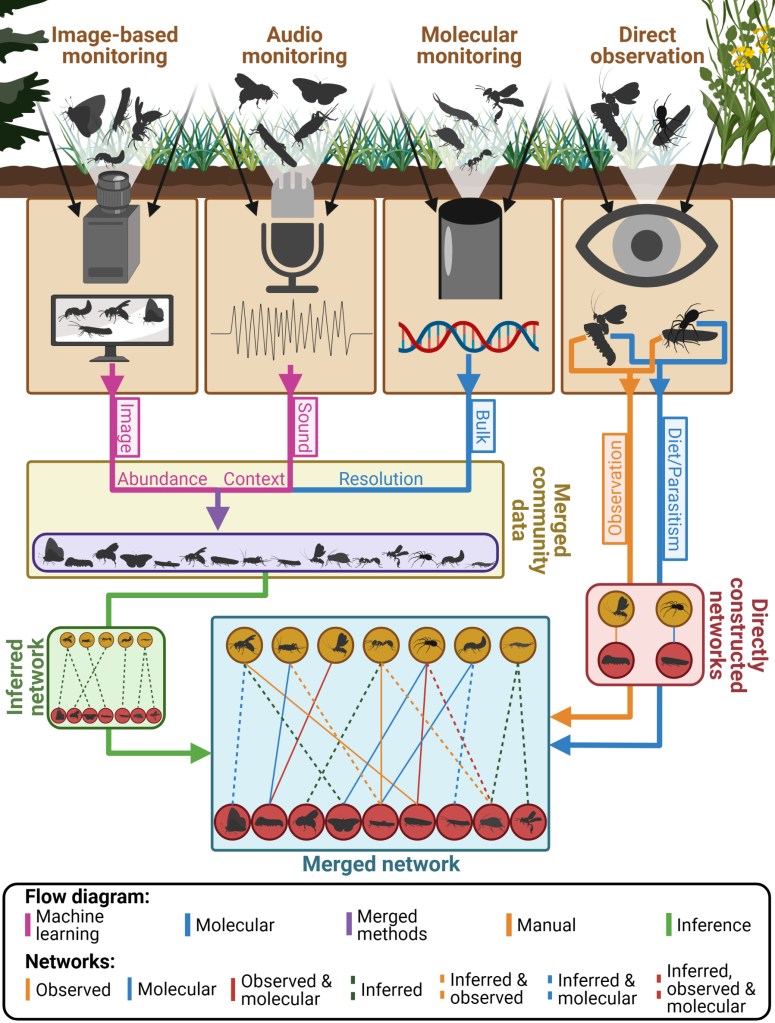
Molecular monitoring has seen massive advances, from sensitive diagnostic assays and new sources of eDNA, through tackling biases and integrating RNA, to long-read sequencing and metagenomics. Analysis of diet and parasitism facilitate direct network construction too!
Accurately inferring networks from community data remains a challenge though. Methods like MaxEnt, matrix autoregression and machine learning can help, but there are many considerations, particularly for molecular community data, and much work is needed!
Merging methods together can increase the breadth of taxa included in communities and networks, but can also add context. This isn’t straightforward given conflicting units, but a lot of guidance is emerging to help! Interdisciplinary collaboration may be increasingly important.
Metrics generated from inferred and merged networks describe the structure and function of ecosystems. Simple bipartite network descriptors are useful, but building toward robustness analyses and integrating data types within multilayer networks extends this significantly.
Some key challenges remain. We suggest that unifying data collection methods, accessing reproducible big data and inferring networks are the three main areas in need of attention. If these can be addressed, the future of biomonitoring will be bright!

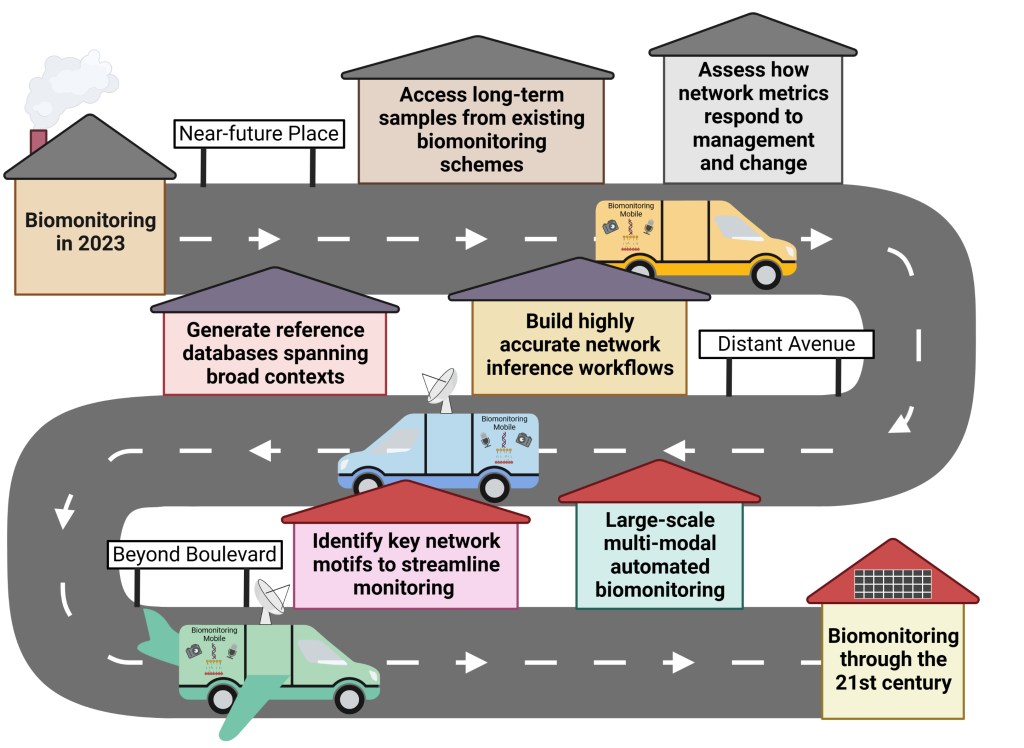
The road ahead will be marked by many milestones, near and far. From using long-term biomonitoring schemes and understanding network adaptability, to streamlining and automating monitoring, the coming years will be an exciting evolution of biomonitoring as we know it!
This was a joint Network Ecology Group effort and we had a fabulous time putting it together! It was great (as always) working together, and particular congratulations to FERG-co-supervised Ben and several of the other authors for whom this is their first peer-reviewed publication!
 Foraging Ecology Research Group