Check out this new preprint, now live on bioRxiv, led by Bram Vanthournout as part of a massive intercontinental investigation of urbanisation effects on spider ecology and morphology:
Urbanization effects are trait-specific and city-dependent across a widespread spider’s global range
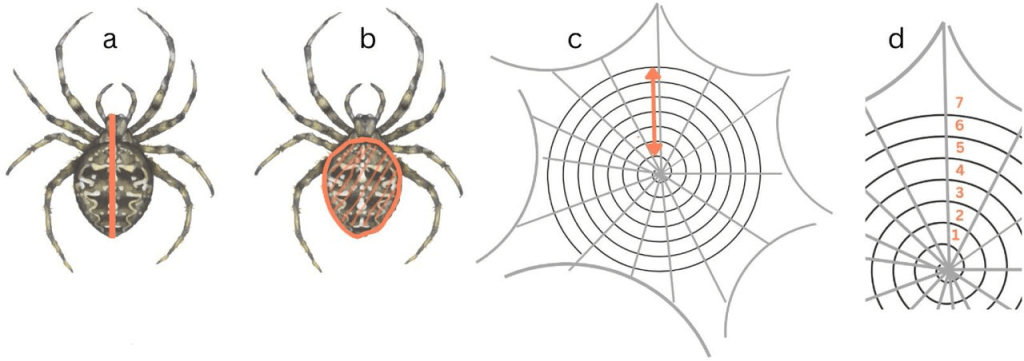
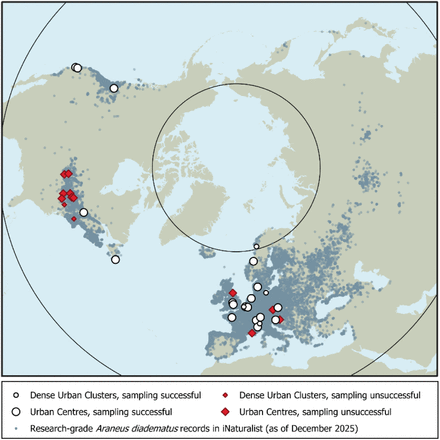
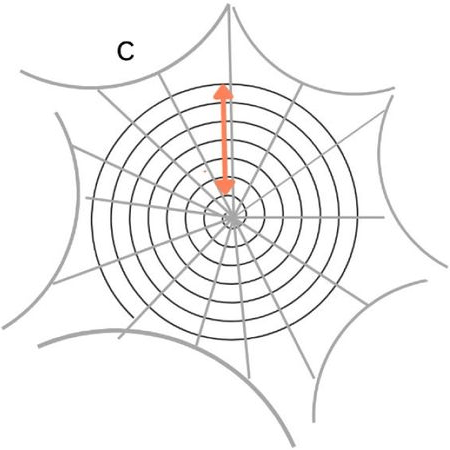
Urban environments impose strong selective pressures through biotic and abiotic factors, driving changes in behaviour, physiology, and morphology. Yet, responses vary across taxa and cities, and it remains unclear which traits respond consistently and what factors moderate this variation. This paper addresses these questions using the widespread European garden spider (Araneus diadematus) as a model, measuring size, colour, and web-building traits along urban–rural transects in 22 cities across its distribution range.
Using a meta-analytic framework, the paper assesses how city-specific characteristics influence trait variation. Urbanisation consistently reduced relative abdomen surface area, a proxy for body condition. Exploratory meta-regressions suggest that web-building response was predicted by temperature: compared to their non-urban surroundings, urban webs are larger in colder regions and smaller in warmer regions. In contrast, body size and abdomen brightness varied among cities without clear environmental predictors.
These findings show that urbanisation effects are trait- and context-dependent, likely influenced by local factors such as heat island intensity, microclimate, or prey availability. Linking within- and between-city variation will improve understanding of species phenotypic responses to urban environments.
Keep your eyes peeled for the peer-reviewed paper in the coming months!