Check out this new preprint, now live on EcoEvoRxiv, from a collaboration co-led by Jordan and Yuval Cohen:
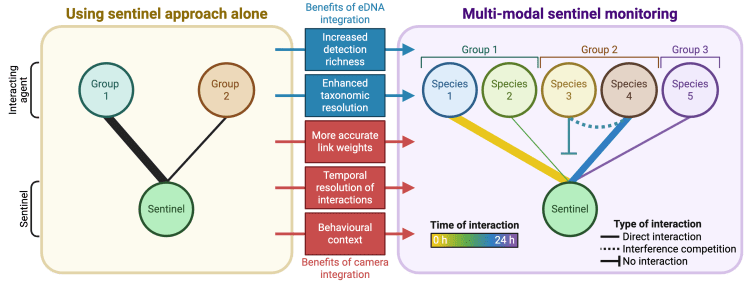
Sentinel approaches can quantify in-field ecological interactions and processes in a semi-controlled way, also reducing bias and labour. The assignment of taxonomic identities to interacting agents is difficult though, and behavioural context and temporal resolution can be lacking. The integration of additional sources of data, including the analysis of DNA left behind on sentinel objects and the use of cameras to observe interactions, presents a valuable extension of sentinel approaches. Several considerations, limitations and obstacles may nevertheless hinder this multimodal integration.
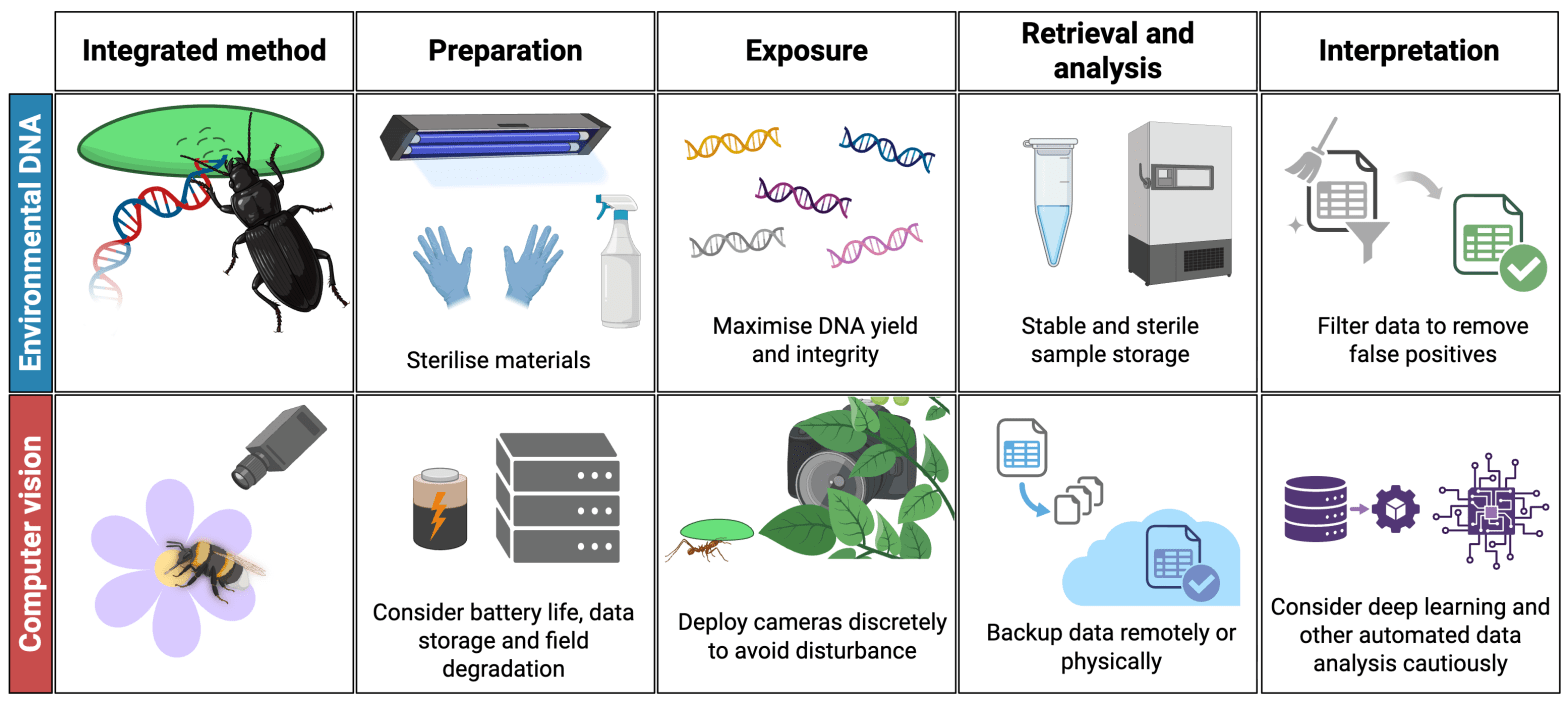
In this paper, we describe the added value that multimodal integration presents for sentinel approaches, focusing on the application of eDNA analysis and camera deployment. The analysis of DNA left on sentinel objects, adjacent substrates or collected from interacting agents themselves presents an opportunity to enhance the taxonomic resolution of sentinel-agent interactions. Similarly, the deployment of cameras, especially integrated with advances in computer vision and deep learning, can enhance the temporal resolution and behavioural context derived from sentinel approaches.
Integrating these monitoring modalities into sentinel approaches will significantly advance the taxonomic, temporal and functional resolution of such studies, but we also acknowledge that this added value is dependent on the specific hypotheses and needs of each study. We discuss the contexts in which multimodal expansion of sentinel approaches should be considered and prioritised. Through the integration of eDNA, cameras, deep learning and broader emerging technologies, we posit that sentinel approaches can transcend a simplistic method for quantifying processes and become a data-rich approach for mechanistic insight into a range of ecological interactions.
Keep an eye out for the paper appearing in a peer reviewed journal soon!