

Check out our new paper, published in Ecological Entomology! “Sources of prey availability data alter interpretation of outputs from prey choice null networks” The data we use to assess prey choice in the field can drastically change what we find. This may be intuitive, but it’s also a little more complicated than you might think…ContinueContinue reading “NEW PAPER: Sources of prey availability data alter interpretation of outputs from prey choice null networks”
Category Archives: Outputs
New preprint: Biomonitoring of biocontrol across the full annual cycle in temperate climates: post-harvest, winter and early-season interaction data and methodological considerations for its collection

Check out the new preprint led by Jordan: Biomonitoring of biocontrol across the full annual cycle in temperate climates: post-harvest, winter and early-season interaction data and methodological considerations for its collection Conservation biocontrol, the regulation of crop pests by naturally-occurring biocontrol agents (e.g., predators and parasitoids), is predominantly monitored throughout periods of primary crop growth whenContinueContinue reading “New preprint: Biomonitoring of biocontrol across the full annual cycle in temperate climates: post-harvest, winter and early-season interaction data and methodological considerations for its collection”
New preprint: Understanding trophic interactions in a warming world by bridging foraging ecology and biomechanics with network science

Check out this new preprint from a collaboration between Jordan, David Labonte (Imperial College) and Fred Windsor (Cardiff University): Understanding trophic interactions in a warming world by bridging foraging ecology and biomechanics with network science Climate change will disrupt biological processes at every scale. Ecosystem functions and services vital to ecological resilience are set toContinueContinue reading “New preprint: Understanding trophic interactions in a warming world by bridging foraging ecology and biomechanics with network science”
New preprint: Metabarcoding advances agricultural invertebrate biomonitoring by enhancing resolution, increasing throughput, and facilitating network inference

Check out the new preprint led by Ben Hawthorne: Metabarcoding advances agricultural invertebrate biomonitoring by enhancing resolution, increasing throughput, and facilitating network inference Massive congrats to Ben on his first first-authored preprint! Biomonitoring of agriculturally important insects is increasingly important given our need to understand a) the severity of impacts by pests and pathogens on cropContinueContinue reading “New preprint: Metabarcoding advances agricultural invertebrate biomonitoring by enhancing resolution, increasing throughput, and facilitating network inference”
NEW CHAPTER: A roadmap for biomonitoring in the 21st century: merging methods into metrics via ecological networks
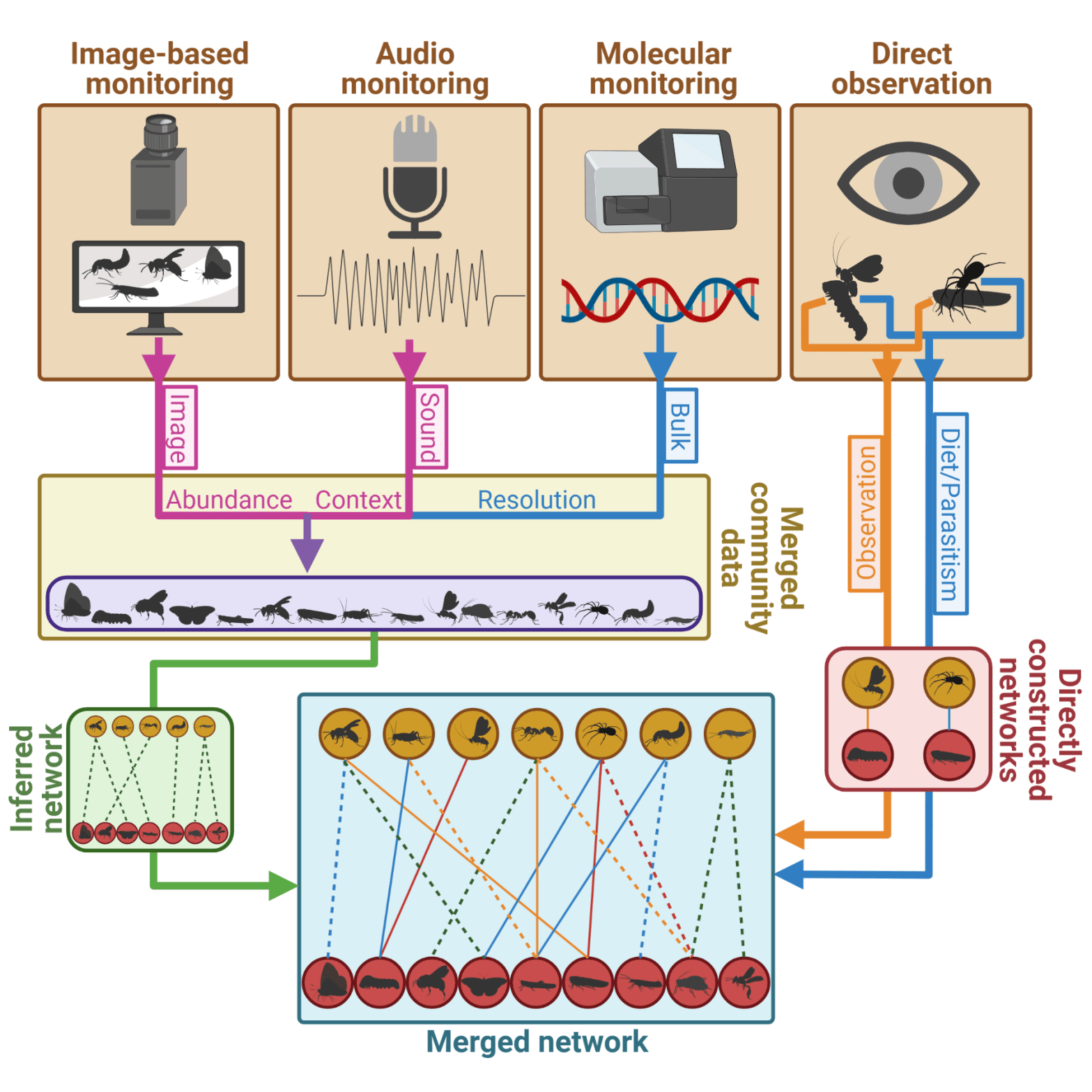
Check out this new chapter in Advances in Ecological Research: A roadmap for biomonitoring in the 21st century: Merging methods into metrics via ecological networks! This was a collaborative endeavour involving most of the Network Ecology Group. The need for widespread, rapid and accurate biomonitoring has never been greater. We summarise some of the massiveContinueContinue reading “NEW CHAPTER: A roadmap for biomonitoring in the 21st century: merging methods into metrics via ecological networks”
New preprint: The case for open research in entomology: reducing harm, refining reproducibility and advancing insect science

Check out the new preprint led by Jordan and co-authored by fellow members of the Royal Entomological Society (RES) Publications Committee and RES journal Editors-in-Chief: The case for open research in entomology: reducing harm, refining reproducibility and advancing insect science Open research is an increasingly important framework within which to develop, share and re-use research,ContinueContinue reading “New preprint: The case for open research in entomology: reducing harm, refining reproducibility and advancing insect science”
New preprint: Sources of prey availability data alter interpretation of outputs from prey choice null networks

Check out the new preprint led by Jordan: Sources of prey availability data alter interpretation of outputs from prey choice null networks! This is also FERG-co-supervised PhD student Ben Hawthorne’s first time authoring a publication! Massive congrats, Ben! Look out for the full paper in the coming weeks/months!
NEW PAPER: Temporal variation in spider trophic interactions is explained by the influence of weather on prey communities, web building and prey choice

This new paper uses multivariate analysis and null network models to investigate how weather impacts the prey communities, diet, foraging choices and web structures of spiders in cereal crops, and how these data could be used to inform predictive models.
 Foraging Ecology Research Group