
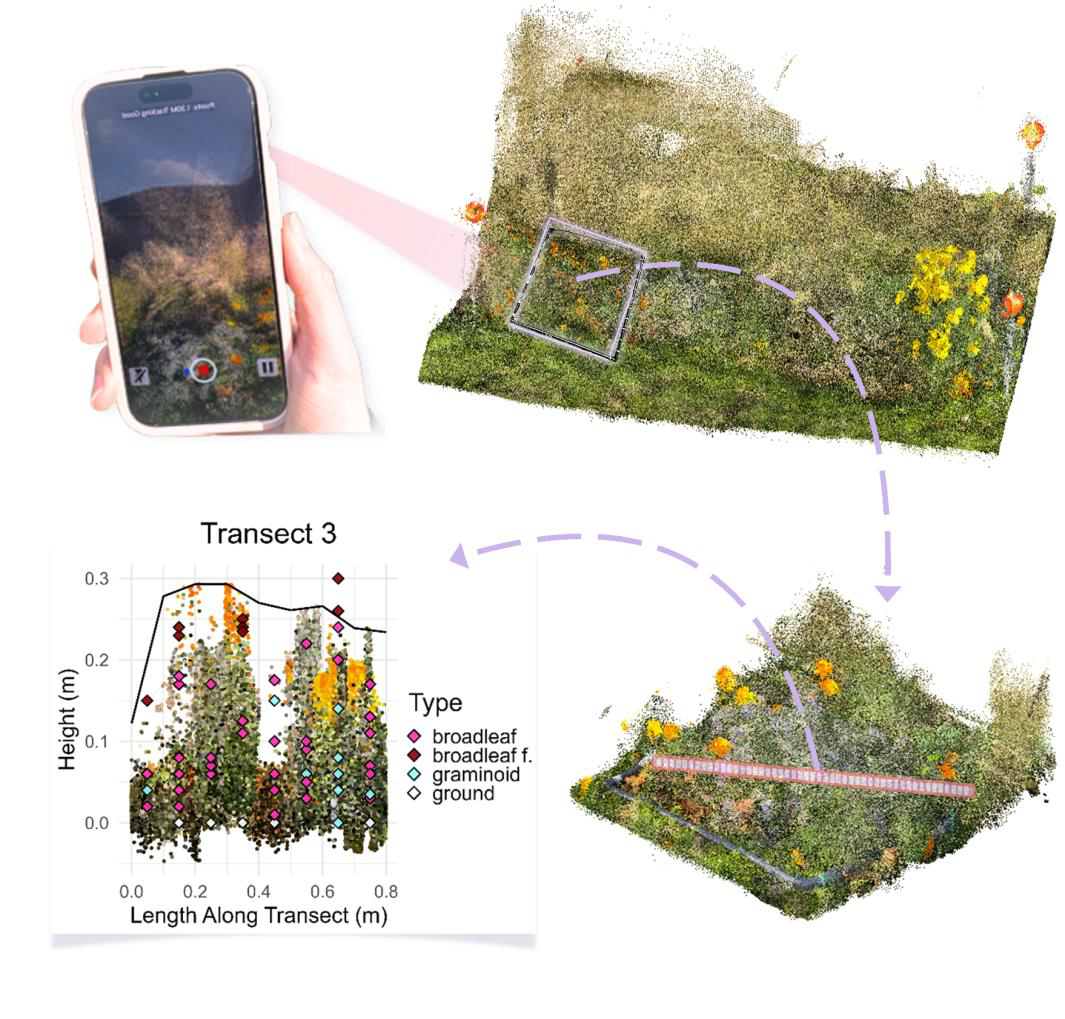
Check out this new preprint, now live on EcoEvoRxiv, led by Broghan as part of her PhD work on remote sensing of vegetation structure!
iPhone lidar can accurately capture fine-scale understorey vegetation structure
Complex vegetation structure increases ecosystem resilience, but fine-scale understorey vegetation is often overlooked in monitoring despite subtle variation impacting overall diversity.
iPhone lidar has placed cost effective and portable remote sensing technology in the pockets of researchers, farmers, practitioners, and citizens worldwide to conduct continuous monitoring and improve policy decisions globally.
This potential is, however, broadly unmet, particularly for the structural assessment of fine-scale vegetation. Measuring heterogeneity of fine-scale understorey vegetation has typically been untenable; requiring either time-consuming manual techniques, or commercial-grade lidar methods which are costly and expertise prohibitive for small areas.
In this study, iPhone lidar was tested for its ability to precisely and accurately measure a broad range of fine-scale understorey vegetation types across five agroforest systems in the United Kingdom, from dense broadleaf understorey to the most challenging sparse graminoid flowers. The entire vertical vegetation profile was evaluated, extending beyond metrics such as maximum height or above ground biomass, justifying the use of methods for a broad range of structural metrics across woodland, grassland, cropland and other ecosystems.
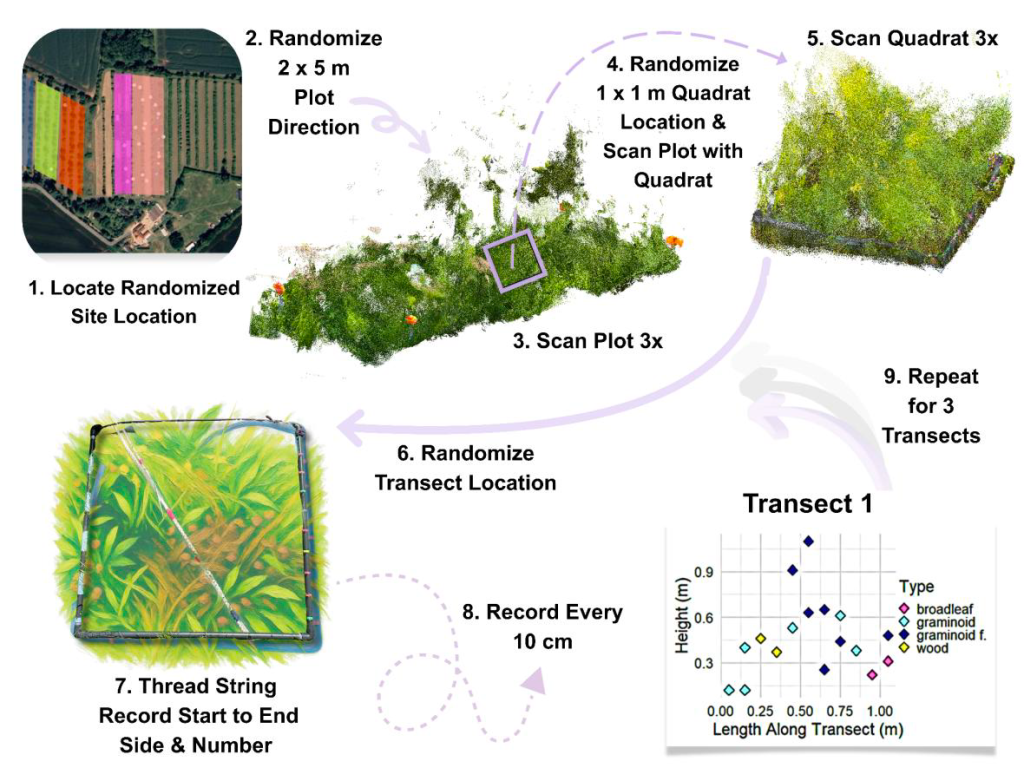
Multiple scanning scales (e.g. 1 x 1 m and 2 x 5 m) were assessed and compared to a commercial grade laser scanner, with the experimental design extending analyses through randomization to contextualize results. Scanning scales of 1 x 1 m and 2 x 5 m areas achieved accuracy of 2.68 cm ± 0.01 and 3.36 cm ± 0.01, with detection rates of 79% ± 2.6, and 72% ± 2.0 across the full vertical vegetation profile, respectively. When excluding sparse graminoid flowers, accuracy increased up to 1.31 cm ± 0.01 with a 93% ± 0.01 detection rate.
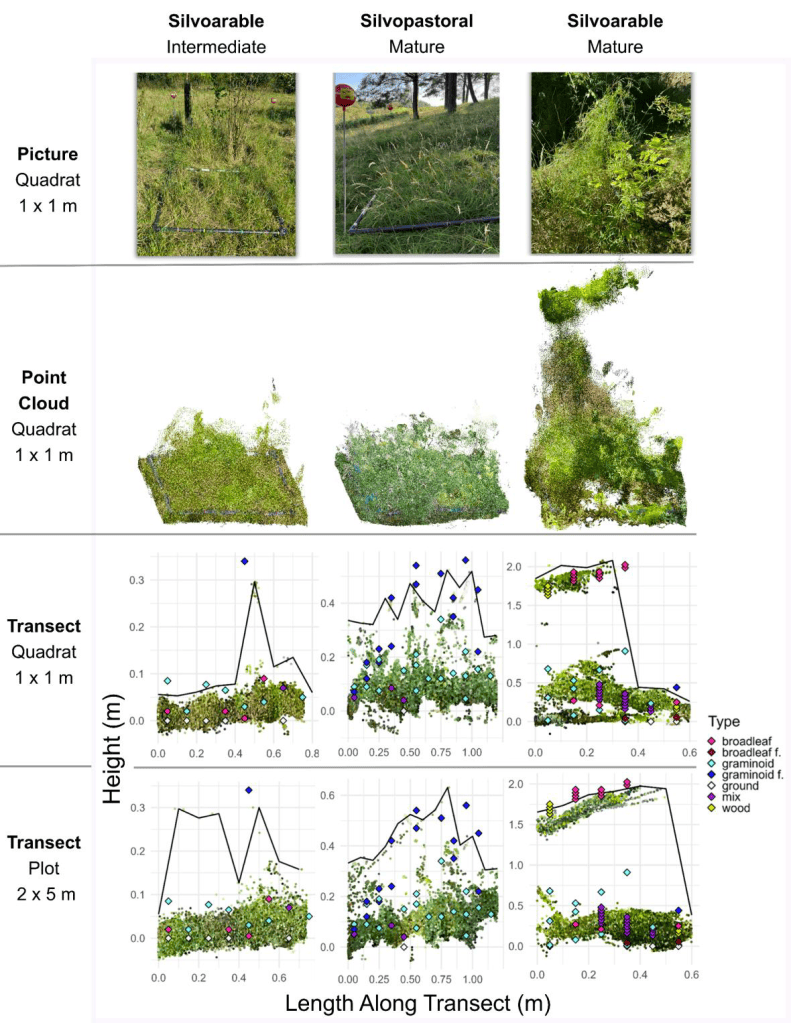
The successful performance of iPhone lidar when measuring fine- scale vegetation structure signifies its potential for a transition towards accessible remote sensing methods to better reflect biodiversity and improve policy decisions.
Stay tuned for more of Broghan’s work, which is coming together rapidly as the final stages of her PhD wrap up!

